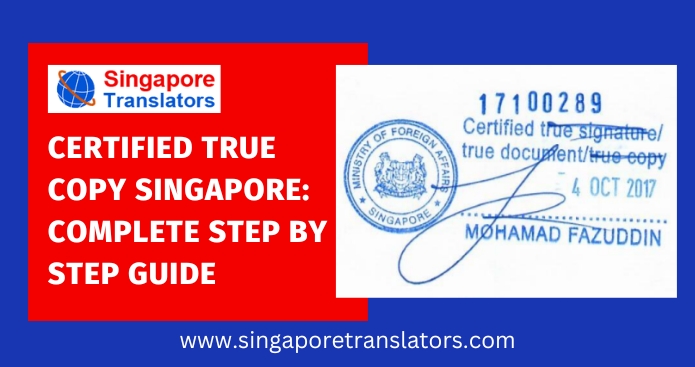
Quick answer: In Singapore, a certified true copy is a photocopy that a lawyer, notary or issuing office has checked against the original and signed. You bring the original and a clear copy. The certifier checks them, then signs, dates and stamps the copy. For use overseas, a notary certifies it. Then the Singapore Academy of Law (SAL) adds an apostille.
This certified true copy Singapore guide shows who can sign, where to go and what to bring. It also covers the usual wording, the fees, and what to do when the copy goes overseas.
What Does Certified True Copy Mean?
Here is the certified true copy meaning in plain words. A certified true copy (CTC) is a copy of a paper with a signed note on it. The note says a trusted person saw the original and the copy matches it. You can send the copy and keep your original safe.
People need CTCs for visas, overseas universities, banks, court cases and jobs abroad.
A CTC is not the same as a plain photocopy. It is also not the same as a fully notarised paper. Want to see them side by side? Read our guide on true copy vs certified true copy vs notarized copy.
Who Can Certify a True Copy in Singapore?
There are three main groups. The right one depends on who will get your copy.
| Certifier | When to use | Notes |
|---|
| Lawyer (practising advocate and solicitor) | Use in Singapore, such as court or estate papers | The Family Justice Courts accept a death certificate copy certified by a lawyer |
| Notary public | Papers going overseas | A notary is a senior lawyer approved under the Notaries Public Act. SAL can add an apostille to their certificate |
| Issuing authority | When the receiver wants the copy from the source | For example, a school can certify its own certificates and transcripts for ICA |
Tip: Always ask the receiving office first. Do they say “notarised” or “certified by a notary”? Then a copy signed by a regular lawyer will not do.
Can a lawyer or commissioner for oaths certify a true copy in Singapore?
A practising lawyer can, mainly for papers used in Singapore.
A commissioner for oaths has a narrower job. Their role is to take oaths for affidavits and statutory declarations used in Singapore. Certifying copies is not part of that role. Many commissioners are also lawyers, so they can sign as lawyers instead. If the receiver names a commissioner, ask them exactly what they need.
Where to Get a Certified True Copy in Singapore
Pick the place based on who will receive the copy.
- Law firms. Good for copies used in Singapore. You can look up practising lawyers in the Ministry of Law’s online list.
- Notaries public. Needed for most papers going overseas. The Singapore Academy of Law (SAL) keeps a directory of notaries and commissioners on legalisation.sal.sg.
- The issuing office. A school, university or agency can certify its own records. Some receivers prefer this.
- Singapore missions abroad. If you live overseas, a Singapore embassy or consulate can certify copies. It must see the original and the copy side by side.
Searching for “certify true copy near me”? Use the SAL directory to find a notary close to you. Call first, as many work by appointment.
What to Bring
- The original paper. The certifier must see it. A scan or a photo is not enough.
- A clear photocopy of every page. Include the back if it has text or stamps.
- Your NRIC or passport. This shows the certifier who you are.
- Any translation. Bring it if the original is not in English.
Make copies the same size as the original, with no edges, seals or page numbers cut off.
How to Get a Certified True Copy in Singapore: Step by Step
- Check the rules. Ask the receiver who must certify. Ask if an apostille is needed.
- Book a visit. Call a law firm or notary. Say how many papers and pages you have.
- Bring your original and copies. Bring ID as well.
- The certifier compares them. They check each page of the copy against the original.
- They sign and stamp the copy. They mark each page, or the first page with a note on the page count.
- A notary adds a notarial certificate. This is only for use overseas. It is a signed statement from the notary. It is tied to the copy with a red ribbon and sealed.
- Pay the fees. You pay notary fees and any SAL fee at this stage.
- Get the apostille if needed. Take the notarised copy to SAL.
Would you rather hand it all to one team? You can book copy certification by a notary public and we set up the visit for you.
Need a Certified True Copy of Your Degree or Passport for Use Overseas?
Certified True Copy Sample: Typical Wording and Stamp
Singapore has no single fixed wording. Most certifiers use something close to this.
“I certify that this is a true copy of the original document, which I have sighted”.
Below that line, you will usually see these items.
- The certifier’s signature.
- Their full name.
- Their role, such as “Advocate and Solicitor” or “Notary Public”.
- The date.
- The firm’s stamp or the notary’s seal.
A notary adds one more part. The notarial certificate says who the notary is and what they certified. It also says where and when. It ends with the notary’s name, signature and seal. Each paper the notary certifies gets its own notarial certificate.
Some clients bring copies that need a stamp on every page for an embassy. Tell the certifier before they start, so the work is done once. Not sure about the format? Document translators based in Singapore like our team can check the request with you first.
How Much Does a Certified True Copy Cost in Singapore?
Notary fees follow a scale set in the Notaries Public Rules. The amounts below are the scale as law firms publish it. Treat them as “from” prices and confirm when you book.
| Item | Fee |
|---|
| Certified true copy, seal needed: first page | From S$10 |
| Each extra page | From S$2 |
| Notarial certificate and seal | From S$75 |
| SAL authentication of a notarised document (apostille) | S$87.20, including GST |
| SAL legalisation of a Singapore public document | S$10.70 per document, including GST |
Here are a few points to know.
- You pay the S$87.20 SAL fee through the notary. This happens before the notary gives the notarial certificate.
- SAL does not charge its separate legalisation fee for notarised papers.
- The law does not set prices for translation and travel time. Each firm sets its own.
So a one-page notarised copy for use overseas starts from about S$85 at the notary. Add S$87.20 if it needs an apostille. A lawyer’s copy for use in Singapore does not need a notarial certificate.
How long does it take?
A simple CTC is often done in one visit. Translation, the apostille and any embassy step each add time. Plan ahead if you have a visa or school deadline.
Getting a CTC of a Foreign-Language Document
Many receivers want two things. They want a certified copy of the original and an English translation. You have two choices.
- Translate first, then certify. The translator makes the English version. The notary then certifies the copy of the original and attaches the translation.
- Do both together. One provider does the translation and the notary step in one job.
A common problem we see is names that do not match. The translation spells a name one way and the passport another. Officers notice this. Ask your translator to copy names just as they appear in the passport.
Does the receiver insist on notarisation? Then a notarial translation package covers the translator’s statement as well as the copy.
Is Your Original Document in Another Language? Get It Translated and Certified Together
Using Certified Copies Overseas: The Apostille
Singapore joined the Apostille Convention. Since 16 September 2021, SAL puts an apostille on every paper it legalises. An apostille is a certificate. It proves the signature and seal on a public paper are real. Other member countries then accept it.
Here is how it works for private papers.
- A Singapore notary public notarises your copy.
- You pay the SAL fee through the notary.
- You take the notarised paper to the SAL counter.
- SAL fixes the apostille to the back of the notarial certificate.
Anyone who gets the paper can check it on SAL’s online search register. The SAL counter is at The Adelphi, 1 Coleman Street #08-06. It opens 9am to 4:30pm, Monday to Friday, and does not take papers by post.
Singapore government papers, such as birth and marriage certificates, are handled by SAL directly. Papers printed from a government system must first be certified by the office that issued them.
Many clients find it hard to fit the SAL trip into a workday. Booking document apostille and SAL submission means someone else queues for you.
What If the Country Is Not in the Apostille Convention?
An apostille only works in member countries. Is the receiving country not a member? Then the paper needs one more step. You take it to that country’s embassy or consulate in Singapore. This step is called legalisation.
Each embassy sets its own rules and fees. Check with the embassy or the receiver before you start. Some embassies only accept papers on certain days. So it helps to arrange embassy legalisation for non-Apostille countries early.
Can You Get a Certified True Copy Online?
In most cases, no. The certifier must see the original. So plan to visit in person.
But some Singapore papers now come in digital forms that can be checked online. These can replace a CTC.
- Court orders: Many orders made after 2013 are free online as an Authentic Court Order at courtorders.gov.sg.
- Death certificates: Some Digital Death Certificates can be checked online. The Family Justice Courts do not need a certified copy of these. For older paper ones, see getting a certified copy of a death certificate.
You can also make the SAL request and payment online. But you still bring the original to the counter.
Certified True Copy for Visa Application Only: What This Means
Some people write “for visa application only” on a photocopy themselves. This marks the copy so no one can easily use it for something else.
This note does not make it a certified true copy. Does the embassy ask for a certified copy? Then you still need a lawyer, a notary or the issuing office to sign it.
Common Mistakes to Avoid
- Bringing only a scan. The original must be there.
- Using a lawyer when a notary is needed. Check the receiver’s wording first.
- Missing pages. Copy the back of each page if it has text or stamps.
- Names that do not match. The translation must follow the passport spelling.
- Laminated originals. SAL cannot add an apostille to them. Get a certified copy or extract from the office that issued them.
- Forgetting the apostille. Ask early if the receiving country needs one.
Sending Certified Copies Abroad? Let Us Handle the Notary, Translation and Apostille Steps
Frequently Asked Questions
I lost my Singapore birth certificate. How do I get a copy to certify?
Apply to ICA for a birth extract on its e-Service. The birth must have taken place in Singapore. It costs S$40 and usually takes up to six working days. ICA only gives digital extracts, so download yours within 30 days.
What if my court order is not on courtorders.gov.sg?
Then file a “Request for Certified True Copy” through eLitigation, the courts’ online system. People without a lawyer can file in person at a Singapore Courts Service Bureau. The Registrar must approve the request.
Can I certify my own documents?
No. A certified true copy must be signed by someone other than you, who has seen the original. Writing “true copy” and signing it yourself makes it a self-attested copy. Some offices accept that, but it is not a certified true copy.
Does ICA want certified true copies for a PR application?
Yes. ICA’s PR page says the documents you upload must be certified true copies of the originals. For papers not in English, ICA also needs an official translation.
What if I lost my Singapore marriage certificate?
Apply online for a duplicate at marriage.gov.sg. This works for marriages registered in Singapore from March 1969. The fee is S$40. You get a digital certificate by email, as paper copies are no longer issued.
Conclusion
Getting a certified true copy in Singapore is simple once you know who should sign it. Bring the original and a clear copy to a lawyer, a notary public or the issuing office. For use overseas, add the notarial certificate and the SAL apostille.
Check the receiver’s rules before you start. Keep names the same on every paper. Is your original in another language? Translate it before the notary visit, so it is all done in one trip.