
Home
Latest updates & news
About Us
About Company and Services
Blogs & Insights
Latest updates & news
Customer Reviews
Need Help?
Call Us
+65 3129 4104
Operating Hours
Mon-Sun: 8AM-10PM
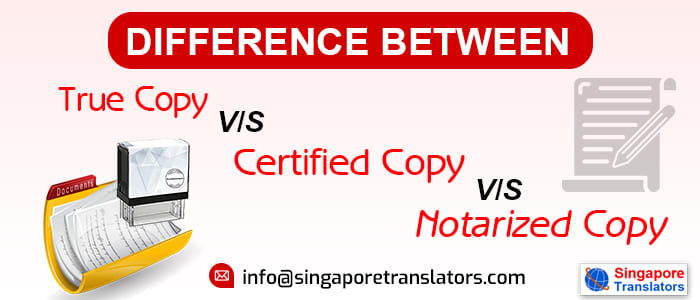
If you have ever filed a visa, applied for a job abroad, opened a bank account, or sent papers to an embassy, you have likely seen three words pop up — true copy, certified true copy, and notarized copy. They sound similar. They are not the same. Pick the wrong one and your application can be rejected, delayed, or sent back. Let’s clear it up in simple words.
Simple rule: notarized = stronger and used abroad. Certified true copy = enough for most use inside Singapore. A true copy on its own has no legal value.
Now let’s break each one down properly.
The true copy meaning is straightforward — it is a plain photocopy or scan of an original document, with no edits, nothing missing, and no extra writing added. If a friend asks for a true copy of your degree, they just want a clean, exact copy. Nothing official. No signature.
On its own, a true copy carries no legal weight because no one has confirmed it matches the original. That is why government offices, embassies, courts, and schools almost never accept a plain true copy. They want proof that someone responsible has checked it against the original document. The original copy meaning, by contrast, refers to the very first document issued by the authority — the one you keep safe at home.
It is a true copy that someone with legal authority has signed. The certified true copy meaning is exactly this — an official looks at your original, compares it to the photocopy, and signs the copy to confirm: “I have seen the original. This copy is complete and exact. Nothing has been changed.” The official also adds a stamp, the date, and their name and designation. That stamp is what gives the copy its legal value.
The CTC meaning is the same thing — CTC is just the short form for “certified true copy” that lawyers and offices in Singapore use every day. So if you see “CTC copy” on any form, it means certified true copy.
This is the version most Singapore agencies accept when they cannot hold your original document. Common situations include visa applications where the embassy will not keep your passport, job applications that ask for certified copies of your degree, opening a bank account with certified copies of your NRIC and address proof, property transactions, and submissions to ICA, MOM, IRAS, or ACRA.
If you need this done properly, our certified true copy services in Singapore handle the full job — document checking, signing, and same-day options.
A notarized copy is a certified true copy with a much higher level of authority behind it. It is signed and sealed by a Notary Public — and that one detail is what makes it the strongest type.
In Singapore, you cannot just walk into any lawyer’s office and get a notarized copy. A Notary Public is a senior lawyer appointed under the Public Notaries Act, usually a Senior Counsel or a practising lawyer with more than 15 years of standing. Only they can notarize. The notary’s seal is recognised by courts, embassies, and government offices around the world.
You usually need a notarized copy when you are sending Singapore documents to another country, when a foreign embassy or university asks for “notarized” documents, when the document will be apostilled or SAL-legalised after notarization, when a court has asked for a notarized version, or when you are signing a Power of Attorney.
If your document is in another language or also needs to be translated, our notarized translation services in Singapore cover the full job — translation, notarization, and embassy legalisation if needed.
People ask this all the time, so let’s settle it: the difference between certified copy and notarized copy comes down to who signs it and where it gets accepted.
A certified true copy by lawyer is good enough for most use inside Singapore. Any practising Singapore lawyer can sign one for you, and many people choose this route because it is faster and cheaper. A notarized copy must be signed by a Notary Public, and it is the version you need when the document will leave Singapore or face stricter international checks.
When it comes to certification vs notarization, both confirm that the copy matches the original — that part is the same. The real gap is the level of authority and where the copy is accepted. Notarised vs certified is essentially the question of “local use” versus “international use.” A simple way to remember: certified for Singapore, notarized for the world.
In the notary vs certified true copy debate, you should also know that a certified true copy notary in Singapore (meaning a Notary Public who signs a CTC) gives you the strongest version available — basically a certified true copy with notary-level authority.
The certified true copy vs notarized vs original comparison confuses most people, so here it is in one clear table.
| Feature | True Copy | Certified True Copy | Notarized Copy |
|---|---|---|---|
| What it is | A plain copy of the original | A copy signed by an official | A copy signed by a Notary Public |
| Who creates it | Anyone | Lawyer, Notary Public, Commissioner for Oaths | Notary Public only |
| Stamp or seal | None | Stamp and signature | Notary seal and signature |
| Legal weight in Singapore | Very low | Strong | Strongest |
| Accepted overseas | No | Sometimes | Usually yes |
| Common use | Internal copies | Visa, job, bank, school | Use abroad, courts, embassies |
| Cost | Free | Lower | Higher |
When comparing certified true copy vs original, remember that the original is the actual document issued by the authority — your real birth certificate, your real degree, your real passport. The certified true copy is a verified replica of it. The certified copy is treated as if it were the original for paperwork purposes, but it is not the original itself.
This is the most common question we get. Who can certify true copy in Singapore? The list is short and clear:
If a government office or embassy asks for a “certified true copy by lawyer,” any qualified Singapore lawyer can do it. If they ask for “notarized,” only a Notary Public will do.
Some documents — like a Birth Certificate or Marriage Certificate — also have a special route: you can get the certified extract directly from ICA. For documents in Chinese, Malay, Tamil, or any other language, our team of sworn translators in Singapore handles the translation side first, before certification or notarization.
If you are wondering how to certify true copy in Singapore, the steps are simple. First, bring the original document — without it, no lawyer or notary can sign anything. Second, bring a clean photocopy or scan. Third, the lawyer or Notary Public will check both, sign the copy, add their stamp, and hand it back to you. Most jobs are done the same day. For full step-by-step details — including what to bring, fees, and timing — see our step-by-step guide to certified true copies in Singapore.
If you are not sure where to get certified true copy in Singapore, you have three main options: a law firm, a Notary Public’s office, or a certification service like ours. All three work — pick whichever is closest or fastest for you.
The certified true copy cost depends on the document and who is signing.
Always ask for a written quote first. Hidden fees can sneak in if you don’t.
Different documents need different levels.
For court, embassy, and cross-border paperwork, see our legal document translation services — we handle translation, certification, and notarization all in one place.
If you need a certified true copy for visa application only, in most cases a standard certified copy from a Singapore lawyer is accepted. Some embassies (for work or study visas in Europe, the Middle East, and a few other regions) ask for a notarized copy with apostille — always check the embassy’s website first.
Use a true copy when you are giving a document to someone who will check the original later, or for internal company use.
Use a certified true copy when you are applying for a visa where the embassy will not hold your original, opening a Singapore bank account, applying for a Singapore job, school admission within Singapore, or HDB, IRAS, ICA, MOM, or ACRA paperwork.
Use a notarized copy when you are sending the document to another country, when a foreign embassy or university asks for notarized copies, when the next step is apostille or SAL embassy legalisation, or when a Power of Attorney needs to be executed.
One-line rule: if the document is leaving Singapore, get it notarized. If it is staying in Singapore, certified true copy is usually fine.
To wrap it up simply:
If you are not sure which one your situation needs, get in touch — we will tell you straight. We have been helping people in Singapore with certified, notarized, and translated documents since 2003.
Our team has been helping people in Singapore with document translation since 2003. We work with certificates, legal papers, ICA documents, and more. Every blog you read here is written by our in-house experts who handle these documents every single day. We share simple, useful guides to help you make the right choices.
View all posts by IsabelleMore insights from our translation experts
Whenever you need Singapore translation services to translate a document, the first thing you do…
The mode of translation to spread business is done by Google Translate and certified translation…

Certificate of incorporation of a parent company Articles of parent company Certification of change of…