Quick answer: The Singapore PR application process is fully online. You apply on the ICA e-Service with Singpass. You upload certified copies of your papers and pay a S$100 fee. ICA usually gives an outcome within 6 months if your papers are complete. If you are approved, you get an In-Principle Approval (IPA) and then complete your PR formalities.
The Singapore PR application process has seven clear steps, and this guide walks through each one. It also covers who can apply, the fees, the waiting time and what happens after approval. If you are asking how to apply for Singapore PR, start here.
Singapore PR Requirements: Who Can Apply?
The Immigration & Checkpoints Authority (ICA) runs every PR application. ICA accepts applications from six groups.
| Applicant group | Who it covers | Who submits |
|---|
| Spouse of a Singapore citizen or PR | A legally married foreign spouse | The citizen or PR spouse, with Singpass |
| Child of a Singapore citizen or PR | Unmarried, under 21, born in a legal marriage or legally adopted | The parent, with Singpass |
| Aged parent of a Singapore citizen | Parent of a citizen aged 21 or older | The citizen child, with Singpass |
| Employment Pass or S Pass holder | Foreigners working here on an EP or S Pass | The applicant, with their own Singpass |
| Student in Singapore | Passed a national exam (PSLE, GCE N, O or A Level) or in the Integrated Programme | The applicant. Singpass from age 15. |
| Global Investor Programme (GIP) investor | Investors approved by EDB | Through the Economic Development Board |
Work Permit holders cannot apply in their own right. No group guarantees approval. The papers you need differ for each group. Our PR document checklist by applicant type lists them one by one.
How much salary do you need for Singapore PR?
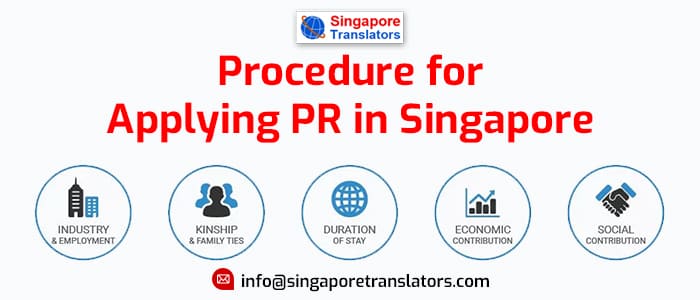
ICA does not publish a minimum salary for PR. Instead, it weighs your whole profile. It looks at family ties, your job and pay, and your qualifications. It also looks at your age, your family and how long you have lived here. It also looks at how committed you are to settling here.
So a higher salary helps, but it is only one part. A stable job and a long stay in Singapore count too.
Is there an age limit, and can Dependant’s Pass holders apply?
ICA does not list an age limit. Age is one of the factors it weighs.
A Dependant’s Pass holder is usually added to the work pass holder’s application as a spouse or child. A foreign spouse of a citizen or PR applies through the spouse group, whatever pass they hold now.
Singapore PR Application for Employment Pass and S Pass Holders
Most applications come from Employment Pass and S Pass holders. Some guides call this the PTS scheme. PTS stands for Professionals, Technical Personnel and Skilled Workers.
ICA does not set a minimum work period. But you need your latest 6 months of payslips and a letter from your employer. So most people apply after at least 6 months of work here.
Degrees are a key part of the review. Is yours in Chinese, Vietnamese or Bahasa? Then get help translating degrees and transcripts. Course names and grades must stay exact.
Singapore PR Application Process: 7 Steps
Step 1: Set up Singpass for every applicant
Each applicant who can get Singpass must check the form with their own login. A new Singpass account can take 2 to 5 working days. So set it up before you start. People who cannot get Singpass use a login that ICA gives them.
Step 2: Collect your documents
You need your passport, birth and marriage certificates, education papers and work papers. Each family member applying with you needs their own set. Each passport must be valid for at least 6 more months.
Children’s papers often hold things up. Order English birth records for each child early, since names must match the passport exactly.
Step 3: Get certified true copies and official translations
ICA asks for certified true copies of your originals. A certified true copy is a photocopy that an approved person checks and signs. Any paper not in English also needs an official translation. This step causes more delays than any other, so start early.
Step 4: Fill in the form on ICA e-Service
Log in to the ICA e-Service. Fill in the form for yourself and any family members. Upload your papers. Check that names, birth dates and passport numbers match on every page.
Step 5: Pay the S$100 fee
Your application is only sent once you pay. The fee is S$100 per application, and it is not refundable. ICA accepts:
- Visa or Mastercard
- American Express
- Internet banking with DBS/POSB, OCBC, UOB or Standard Chartered
- PayNow
Step 6: Wait for ICA’s outcome
ICA usually decides within 6 months if your papers are complete. Some cases take longer. ICA may ask for more papers during this time. Check your status on MyICA or the ICA e-Service.
Step 7: Receive your IPA and complete formalities
If approved, ICA issues an In-Principle Approval (IPA). You only become a PR after you complete the formalities.
Documents Not in English? Get Notarised Translations ICA Accepts Before You Submit Your PR Form
Translation Rules for the Singapore PR Application
Many applicants get this wrong. ICA does not accept just any English version. It accepts only three types:
- A translation by the embassy of the country that issued the paper.
- A translation by a notary public in Singapore or in that country.
- A private translation that the embassy attests, or that a notary public notarises.
ICA also says it does not endorse any private translation company. For most people, the third type is the easiest. A translator prepares the English version, and a notary adds a certificate. Ask for notary public sign-off for translations when you order, so it is done in one go.
Singapore PR Application Fees and Processing Time
These fees come from ICA’s “Becoming a Permanent Resident” page.
| Item | Fee or time |
|---|
| PR application fee (not refundable) | S$100 per application |
| Processing time | Usually within 6 months, if papers are complete |
| Entry Permit (at formalities) | S$20 |
| 5-year Re-Entry Permit | S$50 |
| Singapore Identity Card (blue IC, age 15 and above) | S$50 |
Translation, certified true copy and notary costs are separate. They depend on how many papers you have.
After Approval: IPA and ICA Formalities Appointment
The IPA is not PR status yet. It sets out what you must do and the date to do it by.
- Your appointment: For applications made on or after 26 June 2024, ICA assigns your formalities slot. You can see or change it on the ICA e-Service. If you applied before that date, you book the slot yourself.
- Where: The ICA Services Centre, 2 Crawford Street.
- Originals: Bring them, so ICA can check them against your uploads.
- Medical exam: Do it if your instructions ask for one.
- Fees: Pay the Entry Permit, Re-Entry Permit and IC fees.
As a PR, you need a valid Re-Entry Permit to travel. It lets you come back as a PR. Sons who get PR as a foreign student or through a parent must serve National Service. Check the CMPB website before you apply.
Many families use the same papers again later, for a child’s PR or for citizenship. Keeping your PR paperwork translation in one set means names and dates match every time.
Received Your IPA? Get Your Originals and Translations Checked Before Your Formalities Appointment
Singapore PR Through the Global Investor Programme (GIP)
Investors apply through the Economic Development Board (EDB). They do not use the normal ICA form. Since 15 March 2023, the GIP has three options.
| GIP option | Minimum requirement |
|---|
| Option A | Invest at least S$10 million in a new or existing Singapore business |
| Option B | Invest at least S$25 million in a GIP-select fund |
| Option C | Set up a single-family office with at least S$200 million in assets under management |
Old figures, such as S$2.5 million, no longer apply.
What Are Your Chances, and What If You Are Rejected?
ICA does not publish a success rate. It does publish totals. In 2024, 35,264 people were granted PR, according to the government’s Population in Brief report.
ICA does not give the exact reason for a rejection. Common factors include:
- Missing papers, or papers that do not match
- Translations that are not one of ICA’s three types
- A short time working or living in Singapore
- Lower pay or qualifications than other applicants
- Few family ties to Singapore
How many times can you apply? ICA sets no limit. You can send a new application when you have new or updated information. If nothing has changed, ICA says the outcome will likely be the same.
You can also appeal through the ICA e-Service. The rejection must be within the last 12 months. The sponsor files the appeal, or the main applicant if there was no sponsor. See our sample appeal letter for a rejected PR before you write yours.
Applied Before and Rejected? Reapply With a Clean, Consistent Set of Translated Documents
Finishing the Singapore PR Application Process: Get Your Documents Ready
The Singapore PR application process is simple once your papers are in order. Most delays come from missing papers and translations in the wrong format. A common problem we see is a family that translates papers one at a time. Then names get spelled two ways. Talk to a translation team that handles ICA files before you upload anything.
Frequently Asked Questions
Can I add my spouse or child after I submit my PR application?
Yes. Log in to the ICA e-Service and choose “Add Applicant(s)” on your case summary page. If you applied without Singpass, log in with the Reference ID from your application.
Do I need a PR agent to apply?
No. ICA says it has no link with any outside migration agent or consultant. Agents cannot speed up or guarantee an outcome.
How long is the IPA valid?
The deadline is stated in your IPA. Complete your formalities before that date. If you miss it, the approval may lapse.
Can I apply for my child’s PR later, after I become a PR?
Yes. A PR parent can sponsor an unmarried child under 21 through the child group. Keep the translated birth certificate from your own application, so the names match.
Conclusion
The Singapore PR application process has seven steps. First, set up Singpass and collect your papers. Then get certified copies and translations. Fill in the form and pay S$100. Wait about 6 months, then complete formalities after your IPA.
Most problems come from missing papers and translations ICA does not accept. Prepare early, check every name and date, and use one of ICA’s three translation types.