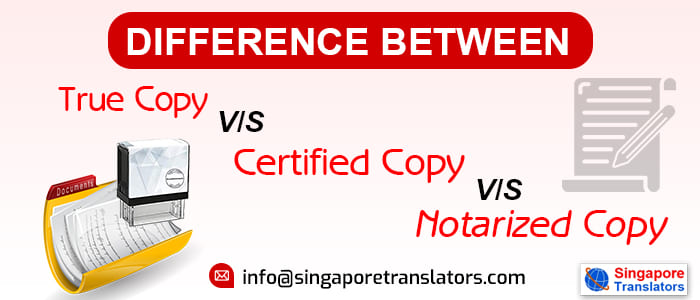
Quick answer: The main difference in certified vs notarised translation is who stands behind the work. A certified translation carries the translator’s signed statement that it is true and complete. A notarised (notarized) translation adds a notary public, who signs a notarial certificate. ICA wants a notarised or embassy-backed translation, while MOM accepts a certified one from a translation provider.
Most people only need one of the two. The office that will read your English version decides which.
Certified vs Notarised Translation: What Is the Difference?
Both types start the same way. A trained translator turns your document into English. The difference is the extra layer of proof added at the end.
Certified translation. The translator or agency adds a signed statement. It says the English version is true to the original. It often has a company stamp and the translator’s details.
Notarised translation. The translator signs a declaration in front of a notary public. A notary is a senior lawyer appointed by the Singapore Academy of Law (SAL). The notary checks who the translator is. Then the notary issues a notarial certificate with a seal.
A notary does not check every word. The notary confirms the identity and the signed declaration. The translator is still the one who answers for the words.
What a good certified translation includes
Look for these parts when you get your file back:
- A statement that the English text is true and complete
- The translator’s or agency’s name and contact details
- A signature and a date
- A company stamp on each page or on the statement
- Page numbers, so no page can go missing
If any part is missing, ask for it before you submit. It is much harder to fix after an officer has seen it.
Certified vs Notarised Translation: Comparison Table
This table sets the three common terms side by side. It also shows what the main offices accept.
| Point | Certified translation | Notarised translation | “Sworn” translation |
|---|
| Who signs | The translator or agency | The translator, then a notary public | The translator, who swears an affidavit of accuracy |
| Exists in Singapore? | Yes | Yes | Yes, as an affidavit. There is no state-appointed sworn title |
| Extra cost | Usually none | Notary fee plus SAL’s fee | Commissioner or notary fee |
| ICA | Not enough on its own | Accepted | Ask ICA first |
| MOM | Usually enough | Also accepted | Usually enough |
| Courts | Depends on the case | One accepted route for foreign judgments | Accepted where the rules allow a translator’s affidavit |
Does ICA Accept a Certified Translation Without a Notary?
Usually not. ICA accepts three kinds of translation:
- A translation from the embassy of the country that issued the document.
- A translation by a notary public in Singapore or in the issuing country.
- A private translation that an embassy has attested or a notary has notarised.
So a plain certified translation from a private firm is not enough for ICA. It needs a notary or an embassy behind it. ICA also says it does not endorse any private translation company.
We often see rushed orders just before PR, citizenship and LTVP visits. If your date is close, read about same-day translation before an ICA appointment.
Who Can Translate My Documents Into English?
The answer depends on who will read the English version. For official files, it is usually a professional translator. A notary or embassy then backs the work when the office asks for it.
Can I translate my own documents?
You can, but ICA would treat it as a private translation. It would still need a notary or an embassy to back it. Officers also trust an independent translator more than the applicant.
Many families hand the whole set to a Singapore agency that certifies translations. That agency then arranges the notary. One team also keeps every name and date the same across all files.
Not Sure Whether ICA Needs Certified or Notarised Translation? Send Us Your Document Today
What Is a Notarised Translation?
“Notary translation” is the everyday name for a notarised translation. Here is how it usually works:
- The translator prepares the English version.
- The translator signs a declaration of accuracy before the notary.
- You pay SAL’s authentication fee at the notary’s office.
- The notary issues the notarial certificate and attaches it.
Most notaries do not translate. They watch the translator sign instead. For birth, marriage and degree certificates, many people order translations that carry a notarial certificate as one job, so the translator and notary steps are booked together.
How Much Does a Notarised Translation Cost and How Long Does It Take?
A notarised translation has three parts to its price:
| Part | Who sets it |
|---|
| The translation itself | The translator, usually per page or per document |
| The notary’s fee | A fixed scale in the Notaries Public Rules |
| SAL authentication | S$87.20 per notarial certificate, including GST |
A certified translation only has the first part. So it costs less. For typical page rates and what pushes them up, see what translation should cost in Singapore.
Time works the same way. A certified translation only needs the translator. A notarised one also needs a notary’s slot, so plan an extra day for that step when you can.
Are There Sworn Translators in Singapore?
In countries such as Germany and Italy, a court or ministry formally appoints sworn translators. Singapore has no state-appointed sworn translators like that. The German and Italian embassies here both say so.
But a translation can still be sworn here. The translator swears an affidavit that the work is true. This is done before a commissioner for oaths or a notary. Court rules here accept a translation backed by the translator’s own affidavit.
So what should you do if a foreign office asks for a “sworn” version? First, ask what it accepts from Singapore. Many accept a notarised translation. Others accept work from translators who swear an affidavit of accuracy.
Why Do Legal Documents Need Notarising?
Notarising adds a check that the reader can trust. The notary confirms who signed, and SAL confirms the notary. That chain matters when the reader is far away or the stakes are high.
Common reasons people notarise legal papers:
- ICA files. Private translations need a notary or embassy.
- Use overseas. Foreign offices often want a notary’s seal before they trust a private paper.
- Court use. Say you want to register a foreign judgment here. The courts ask for a translation certified by a notary or backed by an affidavit.
When a court is involved, ask your lawyer which form it needs. Then order translations for court proceedings in exactly that form.
Need a Translation Signed Before a Notary for an Embassy or ICA File?
Tips for Legal Document Translation
Legal words carry exact meanings. One wrong word can change who owes what. These tips help:
- Send the full document. Stamps, notes and back pages matter too.
- Give the purpose. A contract for a bank and an affidavit for a court need different care.
- Supply spellings. Share passport names, company names and addresses.
- Keep the layout. Tables, clauses and numbering should match the original.
- Allow time for the notary if you need one.
Do you need to translate legal documents to English for a deal or a dispute? Choose a team that works with lawyers. They will know which English legal term matches the original, not just the nearest word.
Certified Translation vs Google Translate
Machine tools are quick and free. They are fine for reading a menu or a short email. They are not fine for an official file. They miss context, and no one signs for the result.
| Point | Machine translation | Human certified translation |
|---|
| Accuracy on names and stamps | Often wrong | Checked line by line |
| Legal and official terms | Literal, may change meaning | Correct local term |
| Layout | Usually lost | Kept as in the original |
| Signed statement | None | Yes |
| ICA, MOM or court use | Not one of ICA’s accepted types | Can be certified and notarised |
A common problem we see is a machine-translated birth certificate that swaps the mother’s and father’s names. Nobody can sign a statement for that. A human translator can.
How to Choose: Certified, Notarised or Something Else?
Ask one question first. Who will read the English version? Then use this simple guide.
- ICA (PR, citizenship, LTVP, Student’s Pass): choose a notarised translation, or ask the issuing country’s embassy.
- MOM (work passes): a certified translation from a translation provider is usually enough.
- A Singapore court: ask your lawyer. The form depends on the case.
- A foreign office: ask what it accepts. It may want a notarised translation and an Apostille.
- A bank, school or company: ask them. Many accept a certified translation.
If two offices need the same document, pick the higher level once. A notarised translation can often serve both. For an ICA file, translation checked against ICA’s rules saves a second round of uploads.
Common Translation Mistakes
These errors cause the most delays with ICA, MOM and banks:
- Names that do not match the passport. Spell every name exactly as in the passport.
- Wrong date format. Write dates in a clear way, such as “3 March 2020”.
- Missing stamps or notes. Translate seals, margin notes and the back page.
- Translating only part of the page. Officers want the whole document.
- Skipping the notary. For ICA, a plain private translation is not enough.
- Mixing up the steps for overseas use. Notary, SAL and embassy are three different stamps.
The last one trips up many people sending papers abroad. Learn how notarising differs from attesting before you book anything. Many people we help only find these mistakes after an office asks for more documents.
Court Papers, Certificates or Contracts in Another Language? Get Human Translators Who Check Every Line
Frequently Asked Questions
What is a notarised letter?
It is a letter signed in front of a notary public. The notary checks the signer’s ID, watches the signing and attaches a certificate. For use abroad, SAL then checks the notary’s signature and adds an Apostille.
Can MOM accept a non-notarised translation?
Yes, in most cases. MOM’s document guide says you upload the original and its English translation together, and a translation service provider can do the translation. It does not ask for a notary.
Can a notarised translation be used outside Singapore?
Often, yes. Since 16 September 2021, SAL issues an Apostille in place of the old authentication certificate. Countries in the Apostille Convention accept it. Countries outside it may also want an embassy stamp.
Do I have to visit SAL in person for an Apostille?
Not yourself. You submit the request and pay online. A proxy can go for you without an authorisation letter. But SAL does not take papers by post, so someone must bring them to the counter at The Adelphi, 1 Coleman Street.
Can the court translate my documents for me?
Sometimes. Court interpreters translate documents from Chinese, Malay and Tamil into English for use in court cases. The fee is $45 per translated page. You should ask at least 4 weeks before you need it, and the court may decline private requests.
Conclusion
The main difference between a certified and a notarised translation is the notary’s certificate. Singapore has no state-appointed sworn translators, but a translator can swear an affidavit of accuracy. ICA wants a notary, an embassy, or a private translation they have backed. MOM accepts a translation from a translation provider.
Before you order, ask who will read the document and what they accept. Then choose the level of proof that fits, and let a human translator do the words.